A laboratory instrument is more than a procurement expense. Its reliability, measurement accuracy, technical support and maintenance directly affect laboratory operations and results.
When comparing authorised laboratory equipments with grey imports, the lower purchase price of grey-market instruments may appear attractive. However, differences in warranty coverage, manufacturer support, software access, spare parts and calibration documentation can affect long-term costs.
When comparing authorised laboratory equipment with grey imports, for Singapore laboratories supporting research, quality control or regulated workflows, procurement decisions should consider the instrument’s suitability, support arrangements and total cost of ownership (TCO), rather than purchase price alone.
Key Takeaways
- Grey-market equipment may be genuine, but manufacturer warranty eligibility, technical support and parts availability can vary.
- Installation, training, calibration, maintenance, repairs and downtime should be included in procurement comparisons.
- Laboratories must ensure calibration records, traceability and equipment controls meet their intended application and quality requirements.
- The right choice depends on technical suitability, verified service terms, operational needs and the instrument’s expected working life.
Authorised Distribution and Grey Imports: What Is the Difference?
Authorised distributors have formal manufacturer relationships to supply specified products within an agreed market. Depending on the manufacturer, these arrangements may include manufacturer-backed warranties, genuine spare parts, technical documentation, software updates and trained service support.
Grey-market equipment, also known as parallel imports, is sourced outside the manufacturer’s authorised distribution channel for the destination market. It may be genuine and functional, but warranty eligibility, service access and manufacturer support can differ.
Neither route guarantees quality or suitability on its own, so buyers should verify the instrument’s origin, specifications, warranty, installation requirements, calibration arrangements and available technical support.
As a laboratory equipment supplier, Green Research Scientific (Greenrs) supplies research and industrial laboratories through authorised manufacturer relationships, supported by local engineering services covering equipment selection, installation, training, troubleshooting and servicing.
The Three Cost Areas Buyers Should Examine
- Warranty Coverage and Service Responsibility
A warranty defines the conditions, duration and scope of repairs or replacements. However, its practical value also depends on how easily the laboratory can access support.
Grey-market instruments may have seller-provided warranties rather than manufacturer-backed local coverage. Buyers should confirm the following points.
- Whether the manufacturer’s warranty is valid in Singapore.
- Who manages claims and provides local technical support.
- Whether labour, travel, parts and shipping are covered, and whether warranty conditions require approved installation or maintenance.
A clearly documented service pathway helps laboratories understand their responsibilities, potential costs and options when an instrument fails.
- Firmware, Software and Manufacturer Access
Modern lab equipments often relies on software and firmware for operation, data collection, diagnostics and system compatibility. Update access and technical support may depend on the instrument model, serial number, software licence, region or service agreement.
Before purchasing, laboratories should establish the following:
- Which software and firmware versions are included.
- Whether updates and technical support are covered during and after the warranty period.
- Whether licences are transferable or assigned to a specific instrument or organisation.
- Whether local engineers can access manufacturer-level support.
- Whether the instrument is compatible with existing laboratory systems.
Recording software versions, licences and update entitlements during installation can simplify future troubleshooting and equipment reviews.
- Calibration Traceability and Supporting Records
Calibration helps laboratories establish confidence in measurement results. Its suitability depends on the parameters and ranges covered, reference standards, measurement uncertainty where applicable, and the competence of the calibration provider.
Singapore laboratories seeking accreditation under SAC-SINGLAS are assessed against relevant standards and technical criteria, including ISO/IEC 17025 for testing and calibration laboratories.
When reviewing calibration certificates, buyers should check:
- Instrument make, model and serial number.
- Measurement parameters and calibration ranges.
- Reference standards and traceability information.
- Measurement uncertainty, where applicable.
- Calibration provider and relevant accreditation scope, if required.
- Any limitations or recommendations for recalibration.
The Singapore Accreditation Council (SAC) provides guidance on laboratory accreditation and measurement traceability. Accreditation applies to defined activities within a laboratory’s recognised scope.
A certificate from an overseas provider is not automatically unsuitable, just as a local certificate is not automatically sufficient. Laboratories remain responsible for ensuring that calibration and verification arrangements meet their specific technical and quality requirements.
Understanding the True Cost of Laboratory Equipment
A lower purchase price does not necessarily represent the lowest total cost. A meaningful comparison should include both planned and potential expenses.
Planned costs include equipment, shipping, installation, training, calibration, maintenance, software and accessories.
Potential costs include unscheduled repairs, replacement parts, additional engineering work, compatibility adjustments, repeat testing and downtime. Estimate these from the instrument’s application and operational risks, since none of them is guaranteed.
Worked Procurement Scenario
The following hypothetical example illustrates how laboratories can compare the total cost of two supply options. All figures are illustrative and should be replaced with actual quotations and operational estimates.
| Cost item | Authorised channel | Grey-market channel |
| Initial instrument price | S$200,000 | S$140,000 |
| Installation and training | Included | S$4,000 |
| Planned calibration | S$8,000 | S$8,000 |
| Potential service and parts | Covered under assumed warranty | S$8,000 |
| Potential downtime impact | S$2,000 | S$8,000 |
| Documentation or remediation | S$0 | S$5,000 |
| Illustrative total | S$210,000 | S$173,000 |
Under these assumptions, the grey-market option remains S$37,000 less expensive, even after the additional estimated costs.
The saving is genuine, so the useful question is how much unplanned cost a lab can absorb before it disappears. Buying a grey-import instrument is, in effect, self-insuring it. We call the point where the saving ends the Break-Even Exposure.
In this scenario, the grey option carries S$21,000 of assumed unplanned cost, and it matches the authorised total of S$210,000 once that exposure reaches S$58,000, which is S$37,000 more than assumed.
One out-of-warranty repair combined with several weeks of lost throughput on a busy instrument can cover that gap. A lab with a spare unit and in-house engineers may never reach it.
If both suppliers include installation, or the grey-market instrument has suitable local warranty coverage, the cost difference may change. Conversely, longer parts lead times or additional technical requirements may increase operating costs.
Procurement teams should compare verified quotations and write down the assumptions behind each figure.
Downtime Can Affect More Than the Service Budget
Instrument downtime can affect sample schedules, staff allocation, testing capacity and reporting deadlines. Its impact depends on whether the laboratory has backup equipment, alternative methods or access to another facility.
Before purchasing, laboratories should consider:
- How many samples or processes depend on the instrument?
- Is a suitable backup or alternative method available?
- Which spare parts are stocked locally?
- What service response times and parts lead times are offered?
- What are the operational consequences of delayed results?
At Green Research Scientific, local engineering support includes installation, troubleshooting, remote diagnostics and technical assistance for distributed brands. Specific service coverage and response commitments should be confirmed for each quotation.
The Greenrs Support-Path Review
To help laboratories compare laboratory equipment suppliers consistently, we recommend assessing the support pathway alongside the technical specification. The following Greenrs Support-Path Review is a proposed framework for structuring that assessment. It brings together the practical questions that can otherwise be scattered across quotations, warranty documents and technical correspondence.
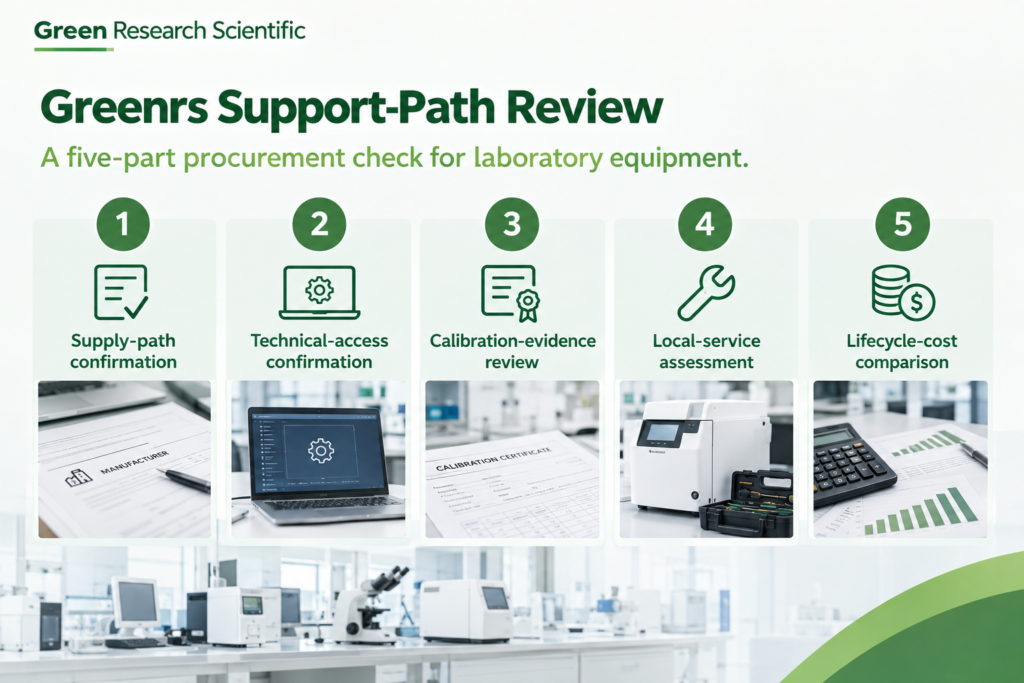
The framework is intended to support a practical conversation between procurement, laboratory operations, quality personnel and the supplier. It also helps create a record of the reasons behind the purchasing decision, including any support conditions that should be reviewed during the instrument’s working life.
Equipment-Specific Support Requirements
Different instruments have different technical and maintenance priorities.
Analytical and imaging systems may require specialised components, software compatibility, application configuration and method-transfer support. Buyers should assess technical assistance, software access and replacement-part availability.
Balances and measurement devices, including thermometers and pH meters, should meet the required range, resolution and accuracy. Calibration, verification and recalibration arrangements should reflect the intended measurements and quality requirements.
Sample preparation equipment, such as mills, crushers, sieving systems and sample dividers, requires consideration of sample characteristics, throughput, cleaning, wear parts and maintenance.
At Green Research Scientific, we supply equipment for sample preparation, separation, thermal processing and nanoscale imaging. Our specification process considers the application and acceptance criteria when identifying suitable configurations.
Singapore Accreditation and Procurement Responsibilities
ISO/IEC 17025 establishes requirements for the competence of testing and calibration laboratories and the validity of their results. In Singapore, SAC-SINGLAS provides the relevant laboratory accreditation framework.
Purchasing from an authorised distributor does not automatically ensure accreditation compliance. Similarly, grey-market sourcing does not automatically prevent compliance. Laboratories must demonstrate that instruments are fit for purpose and supported by appropriate calibration, verification, maintenance, personnel and recordkeeping controls.
Where accredited calibration is required, the provider’s recognised accreditation scope should cover the relevant activity. Procurement decisions should involve laboratory users, quality personnel and technical teams alongside purchasing staff to identify requirements before equipment delivery.
Questions to Resolve Before Purchase
| Question | Purpose |
| Is the model supplied through an authorised Singapore channel? | Establish applicable warranty and manufacturer support. |
| Which warranty applies, and who manages claims locally? | Clarify coverage, responsibilities and costs. |
| Are software, firmware updates and technical support included? | Confirm continued access and compatibility. |
| What calibration records are supplied? | Check suitability, traceability and documentation. |
| Does the calibration provider’s accreditation scope meet requirements? | Verify accredited calibration where necessary. |
| Which spare parts are locally available? | Assess potential repair and replacement delays. |
| Are installation, acceptance testing and training included? | Confirm readiness for laboratory use. |
| What maintenance and service activities are covered? | Identify additional operating expenses. |
| Are response times and parts lead times guaranteed? | Understand service commitments and downtime exposure. |
| What assumptions underpin the TCO estimate? | Ensure quotations are compared consistently. |
Written confirmation for the exact instrument model and configuration provides a useful reference for procurement, installation and ongoing equipment management.
Making an Informed Laboratory Procurement Decision
Authorised distribution and grey-market sourcing offer different supply and support arrangements. Neither route alone determines equipment suitability or total cost.
For some laboratories, grey-market equipment may meet technical, documentation, warranty and service requirements at a lower overall cost. Others may require manufacturer-backed warranties, local engineering support, accessible spare parts and clearly defined calibration pathways.
Tell us about your application. We’ll help you assess the right instrument and support requirements.
Contact us to share your sample type, protocol and key requirements. Our team will review your enquiry and help identify suitable configurations for your application and budget, including the technical and service considerations to clarify before purchase.
Frequently Asked Questions
Is grey-market counterfeit?
Not necessarily. Grey-market equipment may be genuine equipment sourced outside the manufacturer’s authorised distribution channel for the destination market. Buyers should verify the instrument’s origin, serial number, condition, warranty status and available support rather than assuming that all grey-market equipment is the same.
Does buying from an authorised distributor guarantee accreditation compliance?
No. The supply channel alone does not establish whether an instrument meets a laboratory’s accreditation or quality-system requirements. Suitability depends on the intended use, instrument performance, calibration and verification arrangements, documentation and requirements applicable to the laboratory’s scope.
Can grey-market equipment have a valid calibration certificate?
Yes. A calibration certificate should be assessed on its technical content, traceability information, measurement range, uncertainty where relevant, calibration provider and suitability for the intended measurement. If accredited calibration is required, the provider’s relevant accreditation scope should also be checked.
Will manufacturers refuse firmware updates for grey-market instruments?
There is no single rule that applies to every manufacturer or instrument. Update access depends on the product, region, licence and support conditions. Buyers should confirm the exact firmware and software entitlements for the instrument before purchase.
How should a laboratory compare the total cost of equipment?
The comparison should include the purchase price, shipping, installation, training, calibration, planned maintenance, consumables and service costs. It should also assess possible costs from repairs, parts delays, downtime, compatibility work and documentation requirements. These should be modelled using the laboratory’s actual workflow and stated assumptions.